
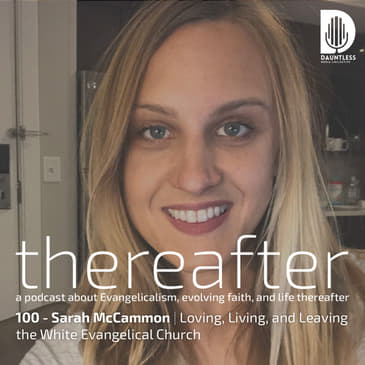


This week we're so grateful to be sitting down with Sarah McCammon. Sarah is the author of the newly released book The Exvangelicals: Loving, Living, and Leaving the White Evangelical Church. She is a National Political Correspondent for NPR and cohost of The NPR Politics Podcast. Her work focuses on political, social and cultural divides in America, including the intersections of politics and religion, reproductive rights, and the conservative movement. She is also a frequent guest host for NPR news magazines and has appeared on the BBC, CNN, PBS, and MSNBC. During the 2016 election cycle, Sarah was NPR’s lead political reporter assigned to the Donald Trump campaign and previously reported for NPR Member stations in Georgia, Iowa, and Nebraska. She lives in Norfolk, Virginia with her husband and two children.
Subscribe to her substack at: https://substack.com/@sarahmccammon
or follow her on Twitter at:
https://twitter.com/sarahmccammon
If you enjoy listening to the show, please consider heading over to apple podcasts to rate and review us. If you really enjoy the show, we would love to see you in our Patreon.com/ThereafterPod! Also, look for us on social media and shoot us a message to say hello, or chat with us in Twitter spaces on Tuesday mornings in deconstruction coffee hour! Twitter: @ThereafterPod, @CortlandCoffey, @ThePursuingLife Instagram: @ThereafterPodcast, @CortlandCoffey, @ThePursuingLife
[00:00:00] This is a Dauntless Media Collective Podcast. Visit dauntless.fm for more content.
[00:00:30] I'd also like to invite you even further into the conversation. Right now, there are some great discussions happening over in the Dauntless Media Collective Discord server.
[00:00:41] If you're interested in chatting with other folks who are deconstructing and decolonizing the oppressive traditions they came from, please feel free to hop onto the server.
[00:00:50] If you don't know what Discord is, it's a place where communities can gather online for chatting on a wide variety of topics.
[00:00:57] In our Discord server, we have channels devoted to general deconstruction conversations, some meme sharing, therapeutic fending about whatever religious bullsh**t you're currently dealing with.
[00:01:08] And even the channel specifically devoted to talking about the latest episode of the podcast you're listening to right now.
[00:01:14] I hope you'll join us. You can log in directly to the Dauntless server by clicking on the link in the show notes or heading to dauntless.fm and clicking on the link in the top banner. See you there!
[00:01:32] Alright.
[00:01:33] Okay. Welcome to the Thereafter Podcast, a place where we explore life on the other side of Faith Change.
[00:01:42] We're here to break down the binaries, deconstruct the dualities and wander through what it looks like to live in the gray.
[00:01:49] In church we were told that life after leaving would be a better wasteland of unfulfilling hedonism, but we've discovered quite the opposite.
[00:01:58] There's actually a vibrant community of people on the other side of Faith who are finding and co-creating space for hope and healing.
[00:02:08] Come along as we explore the all too often uncharted expanse of evangelicalism evolving faith in the life thereafter.
[00:02:28] It's another episode of The Thereafter Podcast, your host here, Cortland and Megan. Megan, hi!
[00:02:34] Hi! I'm good. I just got back from a little vacay in New York City.
[00:02:41] The big apple? Yeah, it's a little bit busy for me. I gotta be inexpensive. Like what?
[00:02:51] Yeah. But yeah, I got to see Ani DeFranco in a Broadway show which comes around full circle. I got to have a meal with Jennifer Gatta.
[00:03:02] That was incredible. So I love her. Yeah, it's nice to go to New York maybe once every 10 years.
[00:03:13] There you go. Yeah. Yeah. I mean, I want to get out there. Last time I was in New York, I was there for like 48 hours and it was for work.
[00:03:24] And I had texted Janice and it was like, we're gonna hang out. And she made time for me.
[00:03:31] And then I ended up not being able to. And I felt terrible.
[00:03:35] Yes, she didn't make your list. I think those were her words.
[00:03:41] She gave me a magic about it when I saw her at content warning.
[00:03:45] So next time I'm in NYC, we're gonna hang for sure. Yeah, no, but I will say I think I've I lived in Chicago for a while.
[00:03:56] I did the whole city thing and I just don't know if I have it in me.
[00:03:59] I saw somebody on the subway with paper towels that they got in a target. And I'm like, man, these paper towels have gone on a journey across lots of subway stops
[00:04:10] from the target doors through lots of other doors to get to your condo apartment, whatever.
[00:04:15] You know, and I just was like, I don't know if I can do it anymore. But you know, I said 11 is for some people. And that's great.
[00:04:23] Yeah. Yeah. I'm not.
[00:04:28] I, you know, there's a romantic aspect of it that I could get into.
[00:04:34] I'm so full of like paradoxes like part of me feels like I would love to like live in the country and like have my walled in moment and ripoetry and chop firewood.
[00:04:46] But then like part of me knows that like I would never like I would lose my mind and would want to be in a city.
[00:04:53] And then part of me is like I could live downtown. I could be hip and have a little studio apartment and, you know,
[00:04:59] check out the washboard.
[00:05:00] I'm a grocery at the bodega and sit in the park. And then I would be like, no, this is too, you know, I don't know.
[00:05:06] My fear is that I'm actually just a suburban person.
[00:05:10] And I am just like built for the suburbs.
[00:05:13] Here's what I think it is. I think just a driveway is nice. Having a place to, you know, pull your car in.
[00:05:20] Although, you know, the pushback could be that in city life, you don't need a car, which is fair. So anyway, we've I would love to not have to have a car like if we design cities different.
[00:05:31] I mean, like it's just very few places. Can you not have a car and have it be sustainable? You definitely can't at Denver. Like we are like our city is not our public transit is not up to it.
[00:05:44] Yeah.
[00:05:45] Yeah. I, um, well let's let's get into that normal podcast content.
[00:05:50] This is just courtland and I catching up, you know, it's been a bit so we always said we would never just record us hanging out and
[00:06:01] it's just not bad. It's, it's unintentional though. It's not like we actually think that you and I pontificating about our future urban living situations is actually interesting content.
[00:06:13] It just happens to be part of the podcast. Maybe we'll cut it out. Probably we won't. This is just what you get. And we have an interesting guest today to make up for it.
[00:06:21] Yes, the great guest. And also I do want to, there is something I want to talk about that's been happening on Twitter.
[00:06:28] And it's something that I'm going to say we've talked about on the podcast. We'll probably talk about it again, but there was, did you see the graphic of don't bully your children about transphobia?
[00:06:43] Um, yes, it was like the person like cutting the wings, the gay wings off of children. Like there were like rainbow wings and they're off was it a children.
[00:06:53] I kind of saw it at a glance and it was like mildly infuriating so I kind of scrolled past it quickly.
[00:06:59] Well, the infuriating I get the reference. Yeah. And somebody shared it and was like, and I'm going to give a content warning for the transphobia but and said like a more appropriate image would be if the
[00:07:12] parents were queer and they were actually cutting the genitals of these children. And it was like so I and because that large, large account shared that it was somebody Dwight that's been in our clubhouse spaces and our Twitter spaces that share the original image.
[00:07:34] And it just opened the door to all of the hate and I had shared it just to say like if you're wondering if trans folks are being targeted right now, go read these comments because the things that are being said right now are so awful.
[00:07:51] And I'm not here and bringing this up because I want to like, perseverate on the awful things that are being said. But what I'm trying to say is I don't think people that aren't in the realm of having like people that are in communities that have trans people in their lives that are in your social circles.
[00:08:11] I don't know if people realize just the level of transphobia that's happening and the things that are being said that aren't simply, you know, not not that this is okay. But it's not just like oh, I don't like trans people or that's not for me. It is very explicit and very targeted and very cruel.
[00:08:32] And I just, I want to bring it up again because we had transphensialical on the podcast and it and she highlighted you know there's not enough trans people to fight this like we need allies. We need advocacy. But I just I want to continue to spread that message that if you're not paying attention, if you think this doesn't impact you, it does impact you in an impacts all our community and it impacts everyone around us.
[00:08:58] And I just, I wanted to mention it. I don't know. Do you have thoughts to add?
[00:09:02] Yeah, yeah. I mean, not to spoil. We have an interview with our friends last. She sat down and hung out with us. That will be coming out at some point. And she mentioned.
[00:09:13] I think either a survey or some piece of data where it was like, you know this, this percentage, a large chunk of Americans who like don't have a single trans friend or person in their life for someone that they know on a personal level.
[00:09:27] And I think that that's a really like when, when these are not people in your life and they're just a talking point for politicians.
[00:09:40] And you know, it makes it even easier for these folks who are perpetuating these really violent harmful toxic narratives about trans folks about queer folks in general.
[00:09:57] And in a way that makes it easier for people to dehumanize them in their mind and other them and not think about the reality of these being people real people.
[00:10:12] And the same way that you know we, other inseparate ourselves from the events that are going on in the Middle East and we don't, you know, realize that like this is, you know, these, these, these are not clips on a movie. This is not, you know,
[00:10:31] something that's happening somewhere else. This is these are real people that are being affected.
[00:10:39] Well, and can I also just say that how infuriating it is when people think that when you, when you say, this head that that's a slur.
[00:10:50] And I was explaining that to someone today on Twitter. They were like, I, I, what, like what does that even mean? That's a slur to me. And I pulled up what comes up on Google.
[00:11:01] And I'm like, Google's right there. Like you can just look at it and see that this, I'm just using a shorthand way to describe a cisgender person that identifies with the gender assigned at birth.
[00:11:14] And also a heterosexual person. And that's not a slur. I'm just, you know, saying that and they were like, that's your queer theory. That's your religion. I don't buy into that.
[00:11:22] And it's just so interesting that people can't even agree on vocabulary. Like it's just like something as simple as a vocabulary word has now become controversial and let alone the humans that are part of this conversation.
[00:11:43] Yeah. I mean, it's, it's foundational to this anti-trans anti-queer ideology. And you know, trans and jungle, she said it really great in that conversation that we had if you haven't listened that episode, go back and listen, it's, it's everything that's non normative.
[00:12:04] Folks who relate to the eye to these normative realities, I mean, it's, it would be like as if somebody saying, you know, well we can reference black folks is black but to reference me as white would be a slur. Right?
[00:12:23] It's because if I think whiteness is the normative, if I think straightness is the normative, if I think that sysness is the correct way, the normal way.
[00:12:35] And these other things are corruptions. They are, you know, they are delegations. They are less than human. They are less than natural, less than valid. Again, it's, these are all bases, a providing a basis for how to dehumanize and other entire people groups. Right?
[00:13:00] You know, we've seen this with the rampant islamophobia that's going on right? Like, you know, if Islam is the other right Christianity is the normative white is the normative. So Middle Eastern Muslim, these things are the anti of everything that people identify with. And when you begin to say like, oh actually in the scheme of things,
[00:13:28] you are other to somebody, right? You as a straight person or other to us as queer people. And when, you know, as we began to look at the data, you started to go like, oh actually there's statistically probably huge numbers of bisexual folks on top of that already known, you know 18 to 20% homosexual folks who identify as that way. I mean, I've seen numbers upwards of like 60% of the time.
[00:13:58] And so the population fall somewhere in that scale, right? That's the majority at this point. I, I, I, Gigazus, Gag Jesus who's on TikTok. He just did a video about this and he was like, you know, there's so much social stigma everyone that is now starting to go like, oh, I can identify as bisexual even though I may be in a, you know, heterosexual relationship or, you know, I may not be actively pursuing a say same same same sex partner.
[00:14:28] It's making it the reality and that's what these people are afraid of right like that is the great replacement theory. That is the idea that, that Christians are going to be replaced, that white people are going to be replaced by non white people that straight people are going to be replaced by queer people that cis people are going and so we have to hold the line
[00:14:49] and stand firm and not give any ground and create this war mentality to defend and stand up for white Christian straight values. And that is how you get Nazis.
[00:15:08] Well, and on top of that, I think there's people that are like if somebody is queer something went wrong with the parenting there was that was that was chatter that was on Twitter like oh, we need to triple down on on the parenting in the control.
[00:15:23] And it's just such a the opposite of what that image was trying to convey right of like somebody being able to flourish and and so are
[00:15:33] in their full selves and their full identity and yet telling people that parents need to triple down on an ability to be queer to be able to come out.
[00:15:47] And I just there's what I think is missing in this whole conversation is the damage that is going to happen to children that have this heteronormativity forced down their throats
[00:16:02] and the based on the fear we're going to come out with the same cycle of conversion therapy and the trauma of purity culture and religious trauma that's been happening all along that we're trying to combat.
[00:16:18] So yeah, it's not parenting people are queer we exist. People are trans we have such incredible incredible humans that were friends with that are trans and I'm so tired of the shit narrative that queer folks are pedophiles or trans folks are pedophiles when it's really like like these I'm sorry these fundamentalists need to look in the fucking mirror because the pet of files are not
[00:16:47] queer folks the pedophiles that we're seeing are the people that are going into religious institutions and using that as a mask for abuse that they want to be able to get away with like I just can't I'm done with that narrative.
[00:17:05] There it is I mean, it's absolutely infuriating and it's it's hard for me to even talk about because I feel like if I say what I really think and feel it's going to get like not that I'm anybody that people would cut clips up of but like it could get cut up it could be set out of context but like this entire
[00:17:25] like violent rhetoric about pedophiles is almost always queer phobia like almost always like like there is this because we can all universally agree that harming a child is just beyond evil right like everyone in the world is like
[00:17:54] right in general can get on the same page and so this idea is to perpetuate this violence around I mean I've seen people wearing shirts kill your local pedophile hang your local pedophile it's and it's and it's cheer for a championed and everyone it is almost always a dog whistle for queer phobia for violence towards queer folks because
[00:18:21] the reality is straight male culture is pedophilic like like straight male culture idealizes barely 18 new by all you just go watch any porn site that you want to see it is barely legal stepdaughter straight culture loves the idea of sexualizing children so this is not a queer thing right
[00:18:49] and the people who are loud and violent about string up your local pedophile they're only that way in order to perpetuate violence towards queer people I in almost all cases because there is actually no accountability held for straight men perpetuating that type of abuse right
[00:19:13] and that's the whole idea of trans people in the bathroom it's not about trans people this is about wanting it's not about protecting bathrooms I guess as I'm saying it's it is about trans people it is about wanting to perpetuate violence against the other and not about protecting women protecting girls guarding against abusers we just know that that's not that's not true that's not the case that's not the end game for the people who are perpetuating these narratives
[00:19:42] I don't know how that's going to come out in the recording but it does it pisses me off too like significantly yeah well I think we had some things we needed to get out to a castle
[00:19:55] we said we were going to keep it short though and we have an incredible guest yeah all that being said let's intro Sarah is delightful she wrote a book called the X-Men at Allicles so glad we got to talk to her about it
[00:20:10] but yeah I'm excited to get into it I'm really we had Sarah scheduled for a long time it was really delightful to finally get to sit down and to be able to get this episode out when her book has just come out is exciting as well
[00:20:22] well let's get into it let's do it welcome back to another episode of the thereafter podcast yeah we're so excited
[00:20:38] we have a guest with us today hello welcome Sarah to the show we're so excited to have you here all I'm excited to be here thank you so much for having me
[00:20:47] yeah Sarah just to kick us off we would love for you to just kind of introduce yourself to our audience or listeners and just kind of tell us a little bit about what you do what you cover
[00:20:57] and I you have a book coming out I've read most of it and so if you want to like just as you do that kind of talk about how that journey of writing that book came about
[00:21:11] and we'll kind of wander from there sure so I'm Sarah McCammon I'm my day job is a national political correspondent for NPR
[00:21:22] I have been in journalism mostly in public radio for 20 plus years now I'm old and most of that has been in public radio
[00:21:33] I grew up evangelical in the 80s and 90s in the Midwest and kind of we can get into this more but you know I think very sort of painful
[00:21:46] and in my for my point of view thoughtful way did not feel careless at all or or like something I took lightly I did walk away from it to one degree or another in my 20s
[00:21:58] there were just a lot of things a lot of sources of cognitive dissonance a lot of things that didn't feel right to me and you know have really since then been in my early 40s now
[00:22:08] so have been kind of trying to make sense of the world like I think a lot of us are
[00:22:13] the part where this book comes along is I had built a career in journalism in you know what we would call secular journalism
[00:22:23] you know not nothing religious for a long time and I had spent a lot of my early years of my career
[00:22:29] in some ways trying to distance myself from my evangelical background I'd gone to an evangelical college and evangelical you know
[00:22:36] to kind of almost the fundamentalist end of the spectrum Christian school felt like there are a lot of gaps in my education
[00:22:42] and also some things that I wasn't super proud of that I didn't necessarily want to talk about in the workplace
[00:22:49] and you know so I had kind of left that behind at least professionally until 2015-16 when I get assigned to not only cover the presidential campaign
[00:22:59] but the Republican primary and eventually Donald Trump and suddenly the thing everybody is thinking about writing about talking about
[00:23:06] is the movement that shaped me that I came from and I am seeing people and themes and ideas that I grew up just entrenched in
[00:23:16] sort of as the focal point of some of the biggest tensions in our culture and in our politics and so out of that I started thinking about
[00:23:25] what I might want to say about it and I started seeing a lot of people like yourselves I think you know on podcasts
[00:23:32] and social media and different sort of public spaces, wrestling with some of these same themes in really public ways that I hadn't seen before
[00:23:39] and I just it seemed to me like something really interesting was happening kind of felt like a movement and a coming together of a sort of a lot of different trends
[00:23:48] that felt like there was something to say and so you know both as a person who had come from that world and as a journalist who likes to tell stories
[00:23:55] I felt like the time was right so I the book I've written is called The X-Fangilicles, Love, Living, and Leaving the White Evangelical Church
[00:24:04] it's part my story and part lots of other people stories.
[00:24:08] Yeah that it's interesting I guess I would love to ask and this gets into kind of your personal story just a little bit
[00:24:17] but that's part of your book so that's there too.
[00:24:20] But one of the things that I was curious about because you talked about going to DC on an internship while you were going to a Christian school
[00:24:28] and just the kind of real world experience that I had something similar where I was at a Christian college
[00:24:35] I almost became a missionary, I was immersed in that Christian bubble and then instead I became a teacher
[00:24:40] and had like my foot in both worlds right?
[00:24:44] You kind of feel like oh I have this job that I go to that's quote unquote secular
[00:24:49] and then I you know try to integrate that.
[00:24:52] And I'm curious like when you first started your career in journalism was it that like oh I'm torn between these two worlds
[00:24:59] I have this kind of secular career but yet I still have these tenants of faith that I'm trying to hold on to
[00:25:06] and like how did that shift kind of while was that kind of mostly because you're so immersed or did the secular world grab you?
[00:25:17] Did you fall? Is that what happened?
[00:25:21] I'm sure no, I don't think the secular world grabbed me. I think a couple of things happened.
[00:25:28] I mean first when I started working yeah my entering the working world was my first time to really be fully
[00:25:35] immersed in a secular environment because I had gone to Christian school and Christian college
[00:25:40] and that was pretty much my whole universe with the exception of a relationship with my grandfather
[00:25:48] who was a central character in this book who was not a Christian who was the person who's
[00:25:55] who really kind of was the target of all of our prayers growing up and a lot of fears and worries on my part
[00:26:02] because of what I was being told about him.
[00:26:04] So he was kind of the contrast or the foil for this evangelical bubble I was existing within.
[00:26:11] So I knew there was something else out there but I had been warned about it, told to pray about it, pray for it
[00:26:17] and don't ever become that.
[00:26:19] So when I did start my first journalism job or two, it was a new experience but I also kind of
[00:26:27] I really wanted to be in mainstream journalism.
[00:26:31] I loved writing, I loved talking to people, I was always kind of verbal and interested in reading and communicating
[00:26:39] I think in retrospect something I write about in the book is that being in a space where questions were encouraged
[00:26:50] and we're actually part of the feature not a bug, that was really exciting to me.
[00:26:55] Like it was kind of empowering and exhilarating to know that I was not only allowed to ask questions
[00:27:02] and consider multiple points of view, I was supposed to, it was like an ethical obligation of my job.
[00:27:07] And I had grown up being surrounded, I just grabbed this parallel universe almost of just the evangelical sort of intellectual infrastructure
[00:27:16] right of books and textbooks and magazines and movies and radio stations and TV stations
[00:27:22] and anything you could think of that would, that the world, quote unquote, would have, even evangelicals had an answer for it
[00:27:28] and a version of it that was designed to, they would say help you maintain your faith or grow in your walk with Christ
[00:27:35] but also for children help sort of protect you and shelter you from the world.
[00:27:40] And so I felt, and I talk about this a lot in the book, but there were just all these points of cognitive dissonance
[00:27:45] and a sense that something wasn't quite right in various ways and being in a space where I was encouraged to ask questions was just so freeing.
[00:27:54] So I think that something, I know that something was already happening in me and had been for a long time
[00:27:59] and journalism kind of felt like a safe place to exist in that uncertainty and that ambiguity.
[00:28:07] And that's one of the things I still love about my work is there are different philosophies about what journalism should be
[00:28:13] and plenty of opinions about how well the media do it and then the media is hundreds, thousands of different people
[00:28:21] and different organizations but I'm still really drawn to the idea of at least trying, you know, not necessarily be totally objective
[00:28:28] and have no opinion but to get it right and be fair and try to understand even perspectives you don't agree with.
[00:28:35] Like I think that's fascinating and I think it's really important.
[00:28:38] So I don't know if that's really answering your question but like, you know, I always knew the world was out there so it's not like it sucked me in.
[00:28:45] But I felt, you know, almost like a calling to be working in a space that was not about starting with the foregone conclusion
[00:28:53] and promoting it to everybody that I knew.
[00:28:56] That was more about just trying to kind of listen, take things in, assess, analyze.
[00:29:02] And so that's what I do, I hope, that's what I try to do.
[00:29:07] Your experience growing up in evangelicalism and its position as a culture in relation to politics and power versus your position reporting in politics
[00:29:22] and the way that evangelicalism is viewed kind of as a voter base or as a demographic by those in the political sphere.
[00:29:34] Do you feel like there has been a shift or do you think, and or is there a different way that you view the relationship between evangelical culture and political power?
[00:29:51] So growing up, I don't think I fully, I mean, I knew that we, we meaning my parents, my church, my teachers, my school, the organizations we were involved in and part of.
[00:30:07] I knew that we had views about politics, right? And the way that the world should be.
[00:30:13] And most people I knew were opposed to abortion and virtually all circumstances, maybe a few small exceptions.
[00:30:19] Most people I knew were opposed to same sex marriage.
[00:30:22] You know, the issues in the 80s and 90s were a bit different than they are today.
[00:30:26] There were still some debates about evolution in schools and I'm sure there are still some but that would seem like it was a bigger issue then.
[00:30:33] Not that it affected me because I went to Christian school but it was still something that our community was concerned about.
[00:30:39] And so there were, you know, there were sort of, I guess what I would have thought of or would have been conceived of as Christian answers to these things, right?
[00:30:47] No real discussion of progressive Christian perspective but what we thought was sort of the Christian perspective on whatever the issue of the day was.
[00:30:56] And I remember hearing like in 1996 when I was 15, when Bob Dull was the Republican nominee.
[00:31:04] There was a lot of frustration on the part of very vocal frustration on the part of James Dobson of focus on the family.
[00:31:13] You know one of the most prominent evangelical leaders then and to some extent still today.
[00:31:18] You know he made a big point of complaining that the Republican party essentially hadn't prioritized abortion enough in its choice of I think, vice presidential pick and so forth.
[00:31:33] And I write about this in the book and I remember that dust up and I remember threats by people like Dobson to leave the Republican party.
[00:31:42] I didn't realize though that evangelicals were such an important voting block or that they really even, that we were called that.
[00:31:49] I guess I'd heard the word evangelical but it wasn't a word that I ever used or we ever used to describe ourselves.
[00:31:56] It was more a word that I heard like when I went off to an evangelical college and sat in Bible classes and we talked about different traditions within Christianity for like the first time ever really.
[00:32:06] The only, this is sort of a side note but the only notion I had of the history of Christianity or the many many divisions within it was this idea that you know there had been this reformation and 1517 when Martin Luther came and sort of enlightened every woman.
[00:32:25] And you know we didn't talk about the fact that the church had existed for like three fours of its current history prior to the reformation or how like the Bible had come together.
[00:32:35] None of that like how the sausage was made stuff so you know I didn't much less did I have any idea that I was part of a particular social political cultural movement called evangelicalism but you know as I go older I kind of realized that's what we're called.
[00:32:49] That's what this is it's a sub sect of Christianity kind of gradually got to realize well maybe not maybe it's not.
[00:32:54] Maybe is not the only way to be Christian for one thing.
[00:32:59] And so I think my like my understanding of that label and it's overlay with political and cultural ideas certainly evolved as I got older and then you know I find myself in my 30s at the time suddenly like I said covering evangelical politics in a really intense way.
[00:33:15] And I mean I think the thing that has shifted in my lifetime and this is not an original idea to me but is really one that I agree with and that I've derived from from my research and people I've interviewed who are smarter than me is.
[00:33:27] I think what's happened is that evangelicalism certainly throughout my childhood it was a political movement but it was it's become I mean it had a strongly political dimension but that has become front and center today in a way I don't think it I think it was on its way then I don't think it was.
[00:33:44] I think then I don't think it was fully there then.
[00:33:49] Yes and I'm curious because you wrote you write about in your book you write about the difference between the response to kind of Bill Clinton and his you know him and Monica Lewinsky versus kind of the response to Trump and some of the things that you talk about a little bit about the hypocrisy and what's what I see happening is
[00:34:12] and Christian Kobe, Kobe's to me writes about this in Jesus and John Wayne but like there's this force that's been building for decades right where now it's coming to wow this this is a very influential voter block but also there's a lot of twisting the narrative to fit into this political box this political agenda and it's changed the way that politics has been approached within that.
[00:34:38] Underneath that umbrella of evangelicalism has changed because of those you know what there's the what they were saying about Bill Clinton they're able to twist those words now when they're responding to Donald Trump and in the way that he interacts with women i'm just curious your kind of perspective on that shift on okay well if it benefits us then we're going to have this perspective if if it benefits have to have a different perspective okay well we'll kind of spin it then.
[00:35:04] I mean I think that's a human tendency I don't think it's just an evangelical tendency you know toward group thing or motivated reasoning but I think you see it I think you see it there.
[00:35:16] It seems to me that a lot of it comes down I mean I was I think about like my reaction to the 2016 trajectory and I think I really you know I was really fascinated like what are even geological is going to do because I remembered how intensely I mean it was a huge topic.
[00:35:33] I mean I think that's a huge topic of conversation.
[00:35:43] Clinton's behavior and I remember so many conversations and many of them sort of led by prominent evangelical leaders about like the importance of character the character is like almost this buzz word and you know I document in the book a lot of the public statements that people like the fall wells and dopsin and others who you know are still around today in various iterations.
[00:36:00] Clinton and how basically this behavior was disqualifying.
[00:36:04] And yet as we all know it seemed like the metric was very different 20 plus years later for Donald Trump and you know it's hard not to think that tribalism and ideology and who's team you're on or not on that that comes into that.
[00:36:27] And I think that and people like Chris and co-host you may have have written about this very well but there was a long standing sort of sense among a lot of evangelicals that their group had been on top and sort of in power.
[00:36:44] And I think that the dominant culture for a long time white Christians were the majority culture in America for so long and then you know about the time that that starts changing because of the sexual revolution and increasing.
[00:36:58] And then there's a lot of diversity and other changes there's a sense of sort of erosion of that and I think you know you see a slowly building movement toward increasing political power with an eye towards sort of preserving that cultural framework that had been sort of taken for granted but is no longer.
[00:37:19] The problem is of course that when you impose a religious framework on a you know on a country that is by design non sectarian with separation of church and state that starts to get very messy very fast and so.
[00:37:35] So you know I think that's that's some of what we're seeing today but but Trump was.
[00:37:40] Trump was was useful to you know he I don't think he made any he made much of an attempt to make people think that he was some kind of sincere evangelical I mean most of the time I think it was pretty obvious he wasn't but he made it very clear to evangelical leaders that he would deliver on their objectives and that I think became supreme.
[00:38:00] Yeah and I wonder in the after math of that what that has shifted within the kind of like deep mind of evangelicalism as a whole in terms of this quiet part being said out loud because you know growing up in the evangelicalism that I grew up in.
[00:38:29] Similar to you know what you're explaining in that time period I never heard people talking about Christian education institutions as a response to.
[00:38:42] De-segregation right and integration of schools and and and now i'm like oh this was very clear like there was this big movement to like establish Christian institutions for schools so that you know we could have white school still and have a religious exemption for that.
[00:39:03] That always that never felt like that was set out loud and now I feel like it's not only being said out loud but there is almost an emboldening of.
[00:39:20] That culture to go it's worth it look I mean yeah Trump is I have evangelical friends who are like Trump is lazy but he got the justice justices you know he got us what he said he was going to do and it's like the ends justify the means has that shifted do you feel like that has shifted even gelco culture as a whole.
[00:39:45] And what is your you know obviously that's a huge question but like be curious what your perspective from where you're reporting is in you know a post Trump hopefully.
[00:39:58] A post Trump for a long time presidency but like you know in where we're at now politically.
[00:40:05] I mean i'm not in mesh and evangelical culture anymore but I think from what i've read and observed um you know i think.
[00:40:15] It's hard to say i mean it's such a large movement i hesitate to characterize it too broadly in that regard but.
[00:40:23] You know from the people that i talked to for my book there was a sense that from some of them that their their churches had moved in a direction they didn't really understand you know that either people in their lives.
[00:40:36] I interviewed some people who who had people close to them who sort of had started out maybe believing in fairly standard.
[00:40:44] Even gelical or maybe charismatic ideas demons and things like that and and moved kind of gradually the one person interviewed talked about a family member you know just moving toward conspiracy theorist thinking.
[00:40:59] Or you know some of the people i talked to kind of watch their churches.
[00:41:04] Seem and at least in their minds to kind of shrug at the George Floyd death the death the killing of George Floyd by police officer in Minneapolis and you know i think for a lot of the people that i've spoken to there's just like a sense of incongruity that.
[00:41:21] Either the movement has shifted and become more extreme in a way that they don't recognize or feel comfortable with.
[00:41:29] Or it's just failed to respond to the moments multiple moments whether that's that's the rise of Donald Trump whether that's racial injustice even the pandemic you know i think a lot of churches saw division over how to deal with the pandemic and that was a tricky thing to figure out a deal with right we were figuring out in.
[00:41:45] In real time and i certainly don't envy the role that public health officials had to play in making those kind of in the moment assessments or other leaders i mean even church leaders i'm sure it was difficult to decide like how long do we mask and how long do we stay home and how do we so much do we distance like those are all.
[00:42:08] All challenging decisions and they you know in in a moment that i think we're in where so many things that feel like they should sort of be ordinary and mundane like do you wear a mask or not suddenly becomes overlaid with politics and ideology and all this sort of larger significance.
[00:42:27] And so in a sense those kinds of things become harder and more fraught and so you know i'm speculating here but.
[00:42:37] What it seems to me that what's happening kind of to the culture as a whole is happening in churches too you know this kind of deepening division around really ideological symbols and.
[00:42:52] I don't necessarily know what caused it or how we how we stop it assuming that we do want to stop it which I think probably we do.
[00:43:00] But it seems to be a feature of kind of this this moment in our culture.
[00:43:07] I mean i was i was thinking about that too because i i'm curious your perspective as somebody who's done this work for 20 years now because it used to be hey there's two things we really don't talk about and that's religion and politics right and now not only is every.
[00:43:21] Not only is everybody talking about it but if you disagree it's breaking your relationship you know and so it's it's breaking up families it's breaking up and i've had people say like to me.
[00:43:31] I feel like you know you're just being too political or when i came out it was like i feel like you just been influenced by your queer friends things and it's just so wild how divisive it has been and i'm just curious like.
[00:43:47] Is that trump is that covid is that like what.
[00:43:52] Tell us Sarah what what did it.
[00:43:55] What was the one single explanation for everything that happens this is going to be a popular episode i just want your perspective because i feel like we all sit around and talk about this and i'm just curious like would you sit around and talk about this what what do you think about this.
[00:44:12] I don't think that it's all trump i mean i think trump is a symptom of something larger you know i i don't think that trump could have walled onto the scene without there being sort of an underlying appetite for something like that.
[00:44:29] Now what led to that appetite i again i mean maybe ask sociologist like i do think that the internet has something some role to play right i mean trump came to prominence and i'm just using him as an example not as the cause to be clear.
[00:44:48] But he came to prominence and part because of twitter right and and his his pension for for tweeting and sort of getting his message out there in really sort of noticeable ways and and i think.
[00:45:01] There's i mean i think that this this characteristic of technology our technology today and it's primarily the social media but not just social media.
[00:45:14] I think it's it's dangerous and it's not just a problem on the right i mean i think that that people on the left should also be mindful of as i was saying earlier like the human tendency toward toward group thing and toward i mean i think something that we saw probably all of us growing up is that the tendency to see toward really rigid orthodoxies like these ideas that you cannot violate if you want to be part of the group.
[00:45:38] And and certainly there should be there should be some things that you can't violate and there should be some sacred principles like you know racism is not okay homophobia is not okay but i think sometimes there is a tendency especially online.
[00:45:55] To just have these kind of you know these really i mean this is not a novel observation but these really reductive conversations and.
[00:46:04] I think i think that's unquestionably a part of a part of what we're dealing with today because like the rhetoric that that moves around so quickly in the kind of herden so quickly online seeps into i think the way people talk to each other and.
[00:46:21] i mean i i love what i do in large part because a lot so much of it is about talking to people face to face and when you're sitting down face to face and hearing someone's tone of voice and watching their facial expressions and their body language you learn so much about them and.
[00:46:38] You know maybe they say something that they're that makes you a little uncomfortable but you can tell they're uncomfortable too when they're wrestling with it like.
[00:46:44] I'm you know i'm much more sympathetic to somebody who is wrestling with an idea than asserting loudly confidently an idea even if it's a sort of harmful when it's like i still want to i want to know that you're that you have.
[00:46:57] Some empathy and some compassion and some struggle you know and the internet makes that it like almost impossible and so i have to use it for work but i am constantly telling myself i need to use it less because.
[00:47:12] It's bad it's not all bad but there's a lot of bad about it yeah so so kind of back to the title of your book and this phenomenon of you know x evangelicals.
[00:47:24] I you know hadn't really been well aware of being evangelical or really knowing that word.
[00:47:32] And i definitely didn't growing up in the church know about people who had left or de converted i heard of people who had converted to Christianity from.
[00:47:44] Atheism or Islam or something else but i never heard stories of people who had left Christianity or left the church to become Catholic or some other tradition and so.
[00:47:58] i'm curious about your take on the phenomenon of x van jelicles and people who have de converted or left their faith or change their faith dramatically and what's brought that about and.
[00:48:15] What that phenomenon you know like why that's happening.
[00:48:21] Like you and i did touch on this earlier but but evangelical is a label that I think has been useful for you know sociologist and democratism pollsters and maybe not one that the most evangelicals call themselves although I think that may have changed somewhat in more recent years as it's become a more common term in the media and it's carried other connotations but.
[00:48:44] Yeah i mean growing up we just call ourselves Christians and I think we thought that our version of Christianity was the right one to put it pretty simply like we were skeptical of definitely skeptical of like groups like Mormonism and even Catholicism and even to some extent mainline Protestantism we saw each of those movements as having certain while yeah.
[00:49:09] And you know the emphasis was just was on really believing in Jesus and being saved and spreading that message to other people so you know as i mentioned earlier.
[00:49:21] The label evangelical is when I kind of realized applied to us later and.
[00:49:27] I mean that I came across the term and I talked about this in the book the term x van jellicle in the course of some of my reporting on the evangelical movement and Donald Trump I was interviewing some women who were struggling with their.
[00:49:42] Even gelical identity and the movements embrace of trump especially in light of the access Hollywood episode.
[00:49:50] And someone mentioned that you know some people are kind of using the term x van jellicle to describe themselves and I that really caught my ear because it seems like.
[00:49:59] You know in the same way that evangelical is this very loose term you kind of know what it means but it's kind of it applies generally to conservative Protestants in a particular subculture.
[00:50:11] It seems to me like x van jellicle describes something to it and it sort of points for me to the idea that if you come from evangelical culture that means something specific and you know there are different manifestations of it different specific.
[00:50:25] You know strains of theology but there is kind of a unifying culture I mean there's especially if you grew up in the 80s or 90s early 2000s you know last 30 40 years there's.
[00:50:35] You know certain types of entertainment certain words there's this idea of purity culture which was so influential for millennial evangelicals and beyond.
[00:50:47] And this is just this whole sort of subculture and set of ideas that come with it and to step away from that means stepping away from a specific community in a lot of ways.
[00:50:58] And you know when I was going through the process that people now called the construction of just trying to figure out what I believed and make sense of things and try to figure out the things that didn't seem to add up.
[00:51:09] There was no word for that there was no online community for it but I think a couple of things have happened in more recent years one is absolutely the internet for all of its downsides it's also made it much easier to find people like yourself and connect with people.
[00:51:26] And so you know at one time if you left a church you might be gossiped about whispered about sort of shunned maybe it maybe there would be an intervention but ultimately if you decided to move on.
[00:51:40] You might really be estranged from people that had once been close to you today that's still maybe true but it's also true that you can you know that there are huge.
[00:51:50] There are hashtags with huge followings you know like X Vangelical and Deconstruction and others on tiktok or Instagram or Twitter and people find each other and they're having these conversations around a lot of different themes whether it is science or politics or queer sexuality or purity culture or any number of other aspects of the evangelical subculture that people have struggled with and that may have prompted them to leave or reconsider some aspect of their faith.
[00:52:18] But I don't think X Vangelical says anything really about what you are now it just says that you have evolved away from that world and but you know I we what I was seeing as I was kind of observing intentionally observing some of these online spaces including you know Facebook groups and so forth is that wherever people landed the experience of leaving that seem to have there seem to be a real commonality and and people were kind of gathering and sharing.
[00:52:47] Gathering and talking around these these kinds of themes and I resonated with a lot of them and so I wanted to write about it.
[00:52:56] Yeah yeah I do I personally I didn't realize it was something that I needed until I found it like I like I didn't and I think that that it's becoming more common for people to leave church and directly find a podcast like ours or a community or you know
[00:53:16] like just like insta like right away I mean I spent five years you know kind of sitting on my couch smoke a weed going what the fuck was that before I like found other people who also had that experience and it wasn't something that I that I really thought that I needed I was so happy to be out of that culture.
[00:53:37] And then to meet someone who also knows who Bob the tomato is and you're like oh you have a piece of identity that I don't know if I've been able to talk to anybody about this before or
[00:53:51] if you're a little older it might be like patch the pirate or salty singing song.
[00:53:56] I don't know if it goes resonate for anybody.
[00:53:59] Yeah yeah absolutely the doughnut man yeah yeah it is it is interesting so I'm curious of your personal experience of like
[00:54:13] did you have a moment of kind of reconnection with earlier aspects of yourself and aspects of this culture you grew up in after pretty functionally living kind of outside of that and like you said more of a secular job and environment.
[00:54:33] What was it like for you to yeah to be of the world to come back and kind of re explore
[00:54:42] and think about these things had it been a while for you since you had thought about some of these things or remembered some of these things from your past.
[00:54:52] Yes and no like I actually don't think that any of this ever is really that far away from me and I don't know maybe maybe that's different from some people but as much as I might have existed in the outside world for a long time.
[00:55:07] I still think about I think I think about aspects of my evangelical background you know every day many times a day some of them are good and some of them are not from my perspective but I think I mean certainly writing this book was an opportunity to re explore those things in a deeper way
[00:55:30] I went back and I dug up some of my old journals and my old letters and even ordered a bunch of books and textbooks online that I had had around my home or my school when I was younger and some of them I was kind of kind of shocked to see you know just how for example some of the textbooks we had in Christian school from like Bob Jones University or a whole question you know how they talked about about race or slavery or gender for sure.
[00:55:59] You know it's probably what you would expect but it very traditional patriarchal roles in some cases what seemed to me like a minimization of not just seem like I mean some of the passages I quote in the book are absolutely a minimization of slavery not a denial that existed but a real failure to really reckon with it.
[00:56:20] And it was kind of I knew that but it was kind of stark for me to read it again all these years later and be like wow this is what I was shaped by and you know to kind of reflect on like wow there I mean I always knew there were gaps but to sort of see them up close again was a little bit humbling and disconcerting.
[00:56:41] And you know then there were also some moments that were really I think kind of sweet like I write in this book pretty honestly about my family and some of its difficult but I also like I share a letter that my mom wrote me after like my first romantic heartbreak and while it is steeped in the language purity culture I think it also it also was a very sweet and kind and it showed a lot of compassion for me you know coming from my mom in the way that she could.
[00:57:11] And I think I came away from the experience of writing the book you know both pretty confident in my in my sense that this wasn't a world I wanted to live in anymore but also you know appreciating some of the things about it that that that shaped me for better or for worse.
[00:57:28] Yeah I hear that and what I love about your writing to is that you bring in your story but then you also you also explain everything as you're kind of documenting the movement and the history and you know I know sometimes we'll have listeners on our podcast that aren't necessarily ex-vanjellicle and so we'll use terms and terminology and language that they're not familiar with and so you're also kind of bringing in all of that context
[00:57:55] and that all of the pieces that pull that together but I know we're kind of getting close to time. One question that I do want to ask though because you talk about this a little bit in the book
[00:58:07] but one thing you talk about is the shifting role of the media and the perspective of the media because when you started it was very different than when you were on the Trump campaign and probably up till now
[00:58:19] and so I'm just curious if you can speak to that and there's been some censorship on social media platforms there's been a lot happening especially on Twitter I know
[00:58:29] and so I'm curious if you can just speak a little bit to that landscape.
[00:58:34] I mean I think I think criticism of the media is nothing new and it's there's nothing wrong with it I mean I think most politicians that I've covered have criticized the press to some extent
[00:58:49] and that's perfectly within their rights and I probably would too if I were in their shoes but I think what I saw when I covered the Trump campaign was an intensity and a rinker around it that I hadn't seen
[00:59:06] and also the sort of the use of the press as kind of the butt of the joke, sort of a scapegoat.
[00:59:16] I've talked about for years people ask what those Trump rallies are like and it's always been a big theme of his rallies to take a moment
[00:59:27] and point at the back of the room and call out the press and say how disgusting and evil those people in the back are.
[00:59:35] And you know it kind of feels like a joke but it's actually you know it is concerning when you see things like the infamous t-shirt that someone wore to it
[00:59:47] you know a Trump rally just before the 2016 election that said rope tree journalist you know it was sort of a suggestion that journalists should be killed.
[00:59:59] That's something that I think there was and I hope well continue to be a one standing bipartisan across the ideological spectrum consensus that that's not something we do here in America
[01:00:12] we have freedom of the press. You can say you can you can criticize the press as much as you want but it's a free public marketplace of ideas.
[01:00:22] We have liberal media, we have conservative media, we have everything in between that's all fine.
[01:00:27] What's not fine is violence and inciting anger and hatred and yes potential violence.
[01:00:36] So I hope that that temperature will be turned down after January 6th I worry even more about that kind of thing.
[01:00:46] I'm not just for journalists but you know anyone in some of these roles that we rely on to protect our democratic institutions.
[01:00:54] You know I and my colleagues have interviewed election officials including Republican election officials who've been threatened and berated and attacked for simply doing their jobs and trying to carry out free and fair elections.
[01:01:07] And that is something that should concern everyone and certainly should concern Christians I think I can say.
[01:01:14] Yeah, yeah absolutely.
[01:01:18] It I went to one Trump rally as a I was there reporting back to the DNC because I was doing a lot of work with not to the DNC but to a democratic group.
[01:01:34] I was there on opposition research essentially but it was there it was terrifying it was a very scary experience for me and I can't imagine.
[01:01:43] I was just like somebody in the crowd I can not imagine being in that context of like in a particular area being specifically pointed out and you know pointed out as the enemy in that space.
[01:02:00] And I mean to your point is not just Trump but it is you know that experience that you kind of talk about is it's scary.
[01:02:09] And you know and the thing I think that I say a lot is or have said many times is that the thing that I think really gave me pause and I haven't been to a Trump rally in a while but I'm sure it will be for long.
[01:02:22] The thing that gave me pause was the fact that people beforehand you talk to them and they're very friendly and normal.
[01:02:30] And then there's something about everybody looking up at a person on the stage who is you know saying these kinds of things and sort of riling up the crowd.
[01:02:44] And the temperature in the room changes and you know I think that's something that a lot of us would probably recognize in a different way if we've been in church right.
[01:02:51] The power of a charismatic figure at the front of the room who has won the trust and the confidence and the admiration of the people in the seats or in the rows.
[01:03:07] And you know I think whoever we are whatever ideological or religious perspective it's important to.
[01:03:15] I mean it's important to maintain a certain healthy skepticism of that.
[01:03:20] Yeah, you know I don't care what letters by their name.
[01:03:24] I do have one more question just kind of random as you wrote your book and you had a pretty good sense of the experience.
[01:03:33] You said you were in these Facebook groups you resonated with the experience you saw what people came out of were there any interviews that you did or did you come across information that surprised you and what was that.
[01:03:45] That surprised me.
[01:03:49] Well I think and I don't want to get too specific for obvious reasons here but I think there were some people I talked to that told me things they asked me not to put in the book or not to put their name to.
[01:04:03] And usually there were things that had to do with.
[01:04:07] Spouses or partners like.
[01:04:10] There were some people who were not on the same page as their partner about certain things aspects of their deconstruction or.
[01:04:19] Just issues related to sort of their identity and.
[01:04:25] I didn't put those in the book but.
[01:04:28] I think the thing that that didn't really surprise me but I guess it highlighted for me is the fact that.
[01:04:34] Because these journeys are so personal and so individual and they happen at different.
[01:04:39] Paces and for different reasons and in different contexts.
[01:04:43] That can complicate all kinds of relationships certainly relationship with family but also relationship with partners.
[01:04:50] And I think we all know that but it was kind of a reminder of that.
[01:04:54] Yeah and I think that's part of why some people don't deconstruct or they put it they put it off even if they're feeling torn and conflicted.
[01:05:01] It's very scary to face those questions because there can be real emotional and social costs for facing them sometimes.
[01:05:11] Yeah yeah absolutely.
[01:05:15] Did you know that?
[01:05:18] No it's just.
[01:05:20] And all the doors by cycle of the room said amen.
[01:05:26] I'm a bit busy two or three does that count?
[01:05:29] Yeah yeah you're in.
[01:05:31] Absolutely.
[01:05:32] We regularly say we're not sure we believe in straight people anymore so.
[01:05:36] To my great regret I really like men but you know.
[01:05:40] Same girl same.
[01:05:44] Well let's give you a chance to plug you know where people can find you engage with your work we always always always encourage people to pre order I know but you're getting close to that release day so.
[01:05:56] Where can people like you follow you and order your book?
[01:06:01] Yeah release days March 19th and yeah pre orders help a lot so if you're thinking about buying the book please do it please do it now.
[01:06:10] It's because it's a huge boost for authors learning all these things about publishing I didn't know but the book is called the X-Fangilicles loving living and leaving the white evangelical church.
[01:06:21] It's available through Macmillan if you just Google it it'll pop up at all the usual booksellers.
[01:06:26] I'm on substack to probably the best way to find me Sarah McCammon my substack is called off the air a journalist after hours thoughts and I have information about the book there too.
[01:06:38] Awesome.
[01:06:40] Well thank you so much for taking the time I know you are busy I hear on the road reporting doing your work doing your writing promoting the book.
[01:06:49] We're really grateful for you taking time and hanging out with us on the podcast today and please go pre order Sarah's book it's really important we say here all the time pre orders matter.
[01:06:59] I don't care that you can get the book in two days on Amazon Prime if you're going to buy it by now.
[01:07:04] It's and then it'll just be there and you don't even have to think about it.
[01:07:08] And I will say if they can say there is an audiobook version as well narrated by yours truly so.
[01:07:15] That's also an option I like audiobook sometimes because I get distracted when I read that will be 1000% how I consume the book will be an audio book.
[01:07:26] While I am cleaning my house probably that's usually what I'm doing awesome so yeah you'll hang out with me while it do dishes relatively soon and I'll be excited about it.
[01:07:36] So yeah thank you for taking the time and we're excited to follow along all the things that you do next.
[01:07:43] Cool well thank you so much.
[01:07:49] All right that's a wrap another one.
[01:07:53] Yeah go check out her book the X-Men dollacles it's available now order it read it it's it's good I've read almost all of it now and it I it made talking to her made me want to like go to journalism school.
[01:08:09] I was like oh this is pretty badass.
[01:08:13] Yes yeah I feel that way when there's a few people who I see doing incredible work Brado Nishi who I forget whether we referenced in that interview or not.
[01:08:25] But you know he's one of those people that I just see him doing this work and I'm like fuck it so that's such good important work and I'm just I get excited by the work that he's doing I'm excited to see Sarah and the work that she's doing as well.
[01:08:38] Yeah for sure well where can people find you Portland on all the socials.
[01:08:45] Yeah I'm all over the internet at Portland coffee I'm the only one C-O-F-F-E-Y Portland like Portland with a C.
[01:08:53] Instagram I'm pretty active on to get me up there Twitter I can't get away from it I'm still there and all the other places Megan where can people find and connect with you as well as the show.
[01:09:06] I actually think you should start you're a big enough name that you should say that your name is Portland like Portland no I'm getting it backwards you should say.
[01:09:17] The Portland is actually Portland with a P but people can find me at the pursuing life on Instagram Twitter all the places check out our Patreon.
[01:09:32] Patreon.com slash there after pod and Instagram and all the things so that's a wrap absolutely that's a wrap until next time everybody we will see you next week.